
Implementing ITIL 4-Aligned Change Enablement and Release Management
Executive Summary
A mid-sized SaaS technology company faced frequent deployment issues, environment instability, and poor visibility across teams. The absence of standardized Change Enablement and Release Management practices led to delays, inconsistent releases, and high post-deployment incidents. To resolve this, an ITSM framework aligned with ITIL 4 best practices was implemented, improving governance, collaboration, and release reliability.
Starting Point
Before implementation, the organization operated with ad-hoc deployments and minimal governance. There were no formal approval workflows, limited documentation, and reactive communication among teams, resulting in frequent production issues and lack of audit readiness.
Findings – The Tangible Gaps
Assessment revealed critical gaps: unstructured change processes, absence of rollback planning, siloed communication, and no visibility into release schedules. Additionally, change types were not differentiated, hindering agile responses and risk management.
Solution Overview
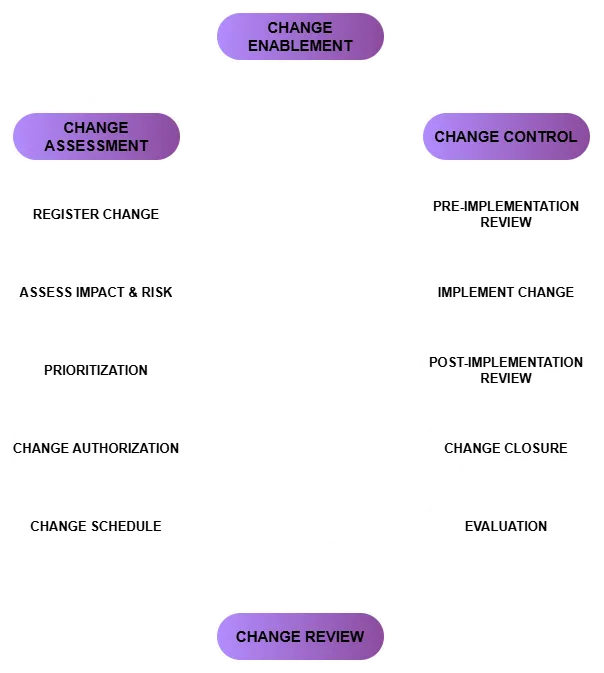
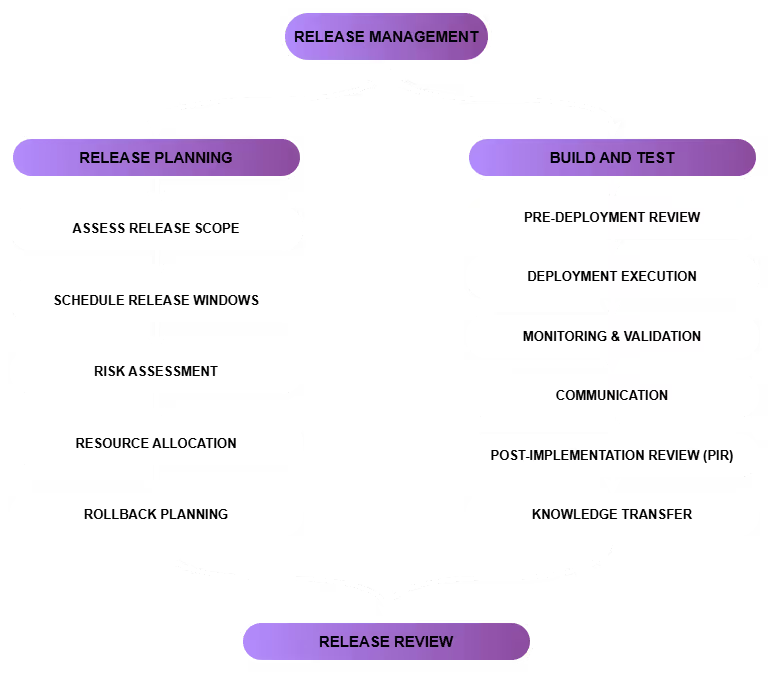
The ITSM team introduced a formal Change Enablement and Release Management framework with ITIL 4 principles. Key actions included defining workflows for Change Requests (Request → Assessment → CAB Approval → Implementation → Post-Review), implementing release planning templates, establishing a RACI matrix, and integrating tools for automated tracking and approvals.
Process Flow Diagrams
Below are the high-definition diagrams for Change Enablement and Release Management processes:
IT Service Operations
IT Service Operations
Results
- 60% reduction in post-release incidents within three months, enhancing system stability and user satisfaction.
- 100% traceability of changes across all environments, ensuring full auditability and compliance.
- Improved deployment success rate through standardized validation procedures and robust rollback plans.
- Enhanced visibility via interactive dashboards and integrated release calendars, supporting better planning and communication.
By streamlining release cycles and introducing a robust, repeatable ITSM framework, the initiative empowers organizations to achieve continuous improvement and scale with confidence.

5255 Orbitor Dr #502 Mississauga,
ON L4W 5M6, Canada
